*NB: Please read to the end. Or skip the rest and go directly to the end.

Hanady’s sitting room is a shrine to her late husband, 31-year-old Awdah Hathaleen, killed in cold blood in July by a settler who was punished with three days of house arrest. With only a small diamond-shaped design of sequins to break the unrelenting darkness of her black draped clothing, Hanady tells me that everything is gone for her: everything left with Awdah: her home life, her future, her dreams, the list goes on.

Note: While I cannot photograph the faces of the Bedouin women of Umm al-Khair, I am encouraged to photograph the children.

A young widow, twenty four years old, in deep mourning, who feels that there is nothing left to wait for, nothing to hope for: many of us can relate. I knew a young widow that age with a one-year-old son who felt that way, too. But eventually she found a new partner and together they gave her son a younger brother, while continuing to honor the memory of her first son’s father. But it will be harder for Hanady.

The most difficult part for her to bear now has to do with her children. Her oldest son, Watan, five, was with his father when he died. In distress, Hanady tells me that Watan remembers and compulsively repeats his account of everything that happened that day. Every detail. He dwells, Hanady added emphatically, on every single memory of the murder, even the tiniest details of that instant, that hour, that day. We agreed that the horror of the moment when his father died next to him will haunt him for the rest of his life.


Everywhere you look in Umm al-Kheir, children are walking, playing, doing chores, caring for one another. While the people of the village are all traumatized, these children are the most affected. Awdah was a magnet and a mentor for them. Several were with him in the playground where he died. Perhaps he took them there to keep them away from the group of protesting villagers and the unhinged settler. Watan’s youngest brother, ten months old, was with them, too. He was found hiding somewhere two hours later.

But not only the children are in crisis. Tariq, perhaps Awdah’s closest friend, has become an unofficial spokesman for the community, always on call to escort or explain things to visitors. He has also taken over Awdah’s English classes, in addition to his own.

Abdallah tells me: “the people of Palestine have finished being angry. They are sad; they are sobbing. But they have no more anger. Palestine is over. Palestine is finished.” He says it obsessively, with finality. “Israel will finish Palestine,” and then says it again, insisting on the distinction between anger and despair.

“I hope not,” I answer. “I would like to see one country, for everybody.”

Fatima would like to see that, too. She has been helping Abdullah convey to me in English his deep feeling of hopelessness. Fatima is an 18-year-old woman who is studying medicine in Hebron. Her community, she tells me, needs a doctor. Fatima’s younger brother Salim is one of the children who was next to Awdah when he died. He saw everything. Terrible nightmares haunt him. The smallest provocation sets off an uncontrollable screaming fit.

I have never seen Eid so intense. He is a sculptor and a wildlife photographer, and when we first met these pursuits dominated his conversation. Now he is completely focused on Umm al-Kheir. He shows me the exact spot on the playground where Awdah was killed, and puts his finger on one of the few drops that continue to stain the pavement after the huge pool of blood there was mostly cleaned away.

A wall was built around the playground. Now if you are outside you can no longer see – and shoot – the people who play, sit, or hide here.
He barely mentions his arrest, with thirteen other men of the village after Awdah’s death – the men were tortured at the notorious Ofra prison. That, along with Awdah’s death, is not what he wants to talk about. What consumes him now is the renewal, a few days ago, of demolition orders in the village. I say renewal because Eid reminds me that the community has been under demolition orders for nearly two decades. Since 2006, with the first operations happening in 2007. Fear of demolition is one of the conditions under which the villagers live, or try to live. Occasionally, the civil administration demolishes their houses. But now he says the behavior of the civil administration has become steadily much worse. “The turning point was when they killed my father” in January, 2022.

Eid may never have seen the driver of the tow truck that killed his father. But for Watan, seeing his father’s murderer continue to walk freely about the village can only have deepened his crisis. After three days of house arrest, this violent man returned to the village to continue overseeing his work of bulldozing land inside Umm al-Khair in preparation for the construction of new homes for the settlement outpost there. The preparations went on with barely a blip of a pause after the murder, and now seven prefabricated houses stand in the area. Looking at them, I realize how the prefabricated houses and the consequences of building them squeeze this neighborhood of Umm al-Kheir, limiting the villagers’ freedom of movement and the use of their land.

Eid shows me the new gate that settlers installed inside the village, along with a limp Israeli flag.

The nearby greenhouse is slated for demolition to make room for more settlement houses, which will naturally involve destroying the fields.

Recently, the Jerusalem district court issued orders forbidding settlers from inhabiting these new homes. That night, immediately after the ruling was issued, settlers moved into the houses. Now they are all inhabited. Today, on Shabbat, the dwellers of the new neighborhood are walking to and from services, their grandchildren following along. Do not photograph their children, Eid warns. It might provoke them.

A few days later, soldiers came and delivered the extensive demolition orders to Umm al-Kheir that Eid has been telling me about. It is a finger in the eye of the courts and anyone who cares about Umm al-Khair. If the judge will issue orders against inhabiting seven pre-fabricated houses, the army will issue demolition orders against twice that many structures in Umm al-Khair, including the community center, the greenhouse, and many private homes, some of which we have helped rebuild when they were destroyed before.

What can we do? Eid grasps for a source of hope. He notes that not long ago, in August, settlers cut the water pipes. After several waterless days in the midst of a summer heat wave, it was not only the lawsuit pressed by human rights lawyer Michael Sfard, but more significantly, international pressure on the heels of the international uproar after Awdah’s murder, that caused the Israeli government to decide to reconnect Umm al-Khair’s water. Perhaps international pressure would do its job again. He has no hopes for any other way to save Umm al-Khair.

There is very little hope in Umm al-Khair, but interestingly, it is Abdallah who provides some indication that there is some scrap of hope left. As I leave upper Umm al-Kheir, he calls to me. There is something that he wants me to photograph. He is intent on showing me what at first glance look like garbage cans scattered about. They are actually metal sheets surrounding new olive trees. The metal enclosures protect the trees from beasts, I assume, primarily animal but perhaps some human as well.


Abdallah is caring for them now. As I watch, he waters them, one by one.

If you can help by contacting members of congress or parliament, state departments or foreign offices, please try.

And watch Eid’s video here or below:
Photographs and Text @ 2025 Margaret Olin
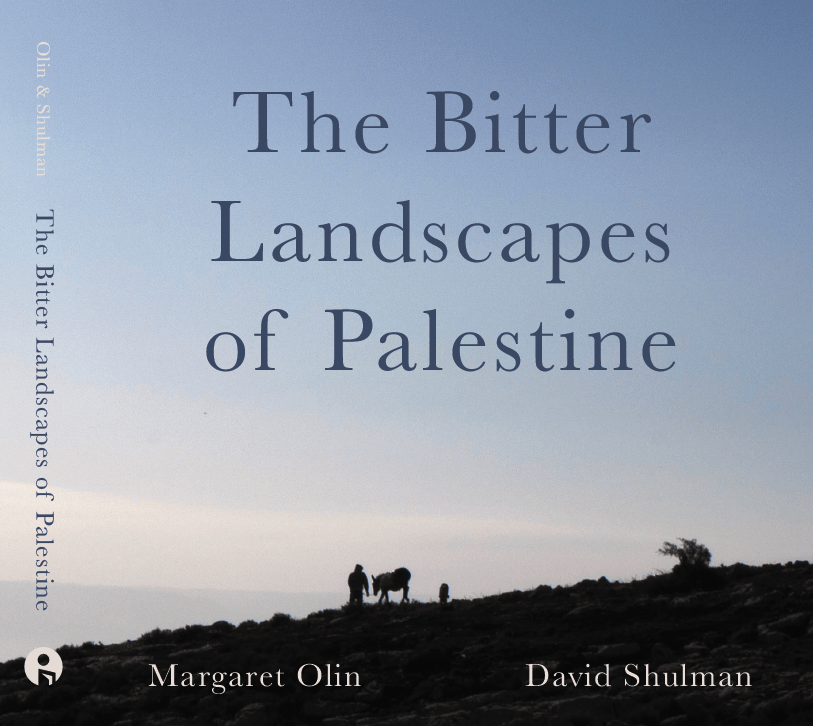
Thanks also to David Shulman. Order our book (below) from Intellect Books, The University of Chicago Press or from an online or local bookseller.
Many thanks Peg for this moving account.
Thanks for reading and all that you do, John.
Thanks very much for this very saddening post, Peg
Appreciated. I wish I had a happy post.